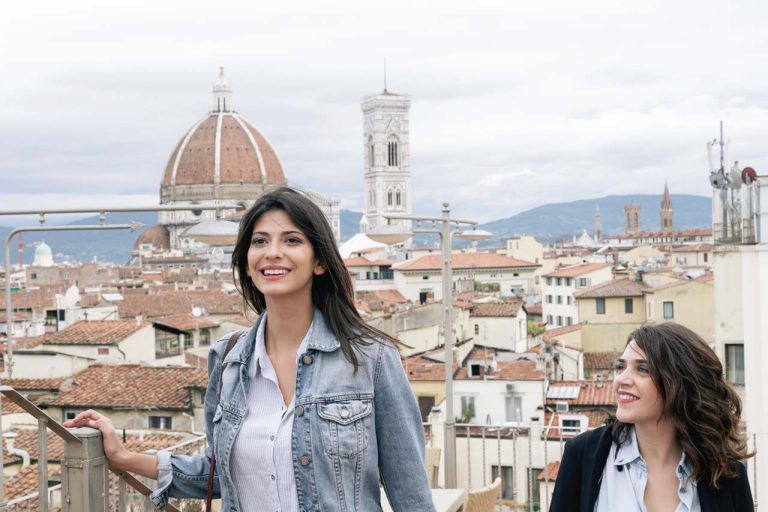
Palazzo Vecchio in Florence: all about the museum and interiors
Palazzo Vecchio is one of the most important buildings in the city, the seat of the Comune, a symbol of power, cultural landmark and emblem of 14th-century Florentine civil architecture.
It is located in the iconic Piazza della Signoria, in the heart of Florence’s historical centre.
Palazzo Vecchio has always hosted the powerful who have ruled the city over the centuries, as well as being the seat of the Parliament of the Kingdom of Italy from 1865 to 1871.
Surprising and fascinating, the interiors allow for an authentic journey into the art and Florentine history. A journey we make through the floors and rooms of the Palazzo Vecchio and the Museum:
- Underground: the archaeological route allows visitors to admire the remains of the Roman theatre of ancient Florentia. Multimedia aids allow visitors to learn about portions of the theatre built in the 1st century and subsequently enlarged, but also allow visitors to discover medieval buildings and streets;
- Ground floor: images and works of art from the municipal collections guide us on a itinerary that recounts the history of Florence and its urban development from the Renaissance to the present day;
-
First floor:
- The Salone dei Cinquecento: 54 metres long and 23 metres wide, it is one of the most important and renowned in Italy. It was built in 1494 by Simone del Pollaiolo. The project was commissioned by Savonarola to create the seat of the Major Council, composed of 1,500 people who were called to meet here in groups of 500. From 1865 to 1871 it housed the Parliamentarians of the Kingdom of Italy;
- Studiolo di Francesco I: designed by Vasari and built in mannerist style, it is a small windowless room, with walls completely covered in stuccoes, paintings and sculptures;
- Quartieri Monumentali: rooms designed to celebrate the cult of the Medici family, finely decorated and used for a long time as representative rooms of the mayor of Florence. Today they can be visited in part: tourists can enter the Hall of Leo X and the Hall of Clement VII.
- Room of Leo X: dedicated to the son of Lorenzo the Magnificent, the one who during the 16th century helped consolidate the power of the Medici family and who was the 217th Pope of the Catholic Church, from 1513 to 1521;
- Room of Cosimo the Elder: dedicated to the politician and banker who is unanimously recognised as the first statesman of the Medici family;
- Room of Lorenzo the Magnificent: dedicated to the Lord of Florence from 1469 to 1492. He was also a writer, patron, poet and humanist;
- Cosimo I Room: dedicated to the second and last Duke of Florence (1537-1569) and then first Grand Duke of Tuscany (1569-1574);
- Room of Giovanni dalle Bande Nere: dedicated to Ludovico di Giovanni de’ Medici, Renaissance condottiere and exponent of the Popolano branch of the Medici;
- Scrittoio: a small room next to the Sala di Cosimo I;
- Chapel of Saints Cosmas and Damian: dedicated to the patron saints of the Medici family;
- The Ricetto;
- Sala dei Dugento: a room where the city council meets;
- Sala degli Otto: small room used as an office.
-
Second floor: a monumental staircase leads to:
-
Quartiere degli Elementi: consisting of five rooms and two loggias. At one time housed the private flat of Cosimo I. It was later divided into:
- Room of the Elements;
- Sala di Opi;
- Hall of Ceres;
- Cryptium of Calliope;
- Hall of Jupiter;
- Terrace of Gunone;
- Hall of Hercules;
- Terrace of Saturn.
-
Eleanor’s Quarters: accessed via the Hall of the Elements, along the gallery facing the Salone dei Cinquecento. It was designed by Giorgio Vasari for Eleonora di Toledo, wife of Cosimo I. Consisting of:
- Green Room;
- Eleonora’s desk;
- Eleonora’s Chapel;
- Sala delle Sabine;
- Hall of Esther;
- Hall of Penelope;
- Hall of Gualdrada.
- Cappella dei Priori: dedicated to St Bernard, it was used by the Priors to plead for divine help. It was built by Baccio d’Agnolo between 1511-1514;
- Sala dell’Udienza: also called Sala della Giustizia, it hosted the meetings of a Gonfalonier of Justice and eight Priors;
- Room of the Lilies: named after the fleur-de-lys, symbol of the French crown;
- Map Room or Wardrobe Room: accessible from the Sala dei Gigli, was used by the Grand Dukes to store their precious possessions;
- Old Chancellery: accessible from the Sala dei Gigli, it was Machiavelli’s office in the period when he was Secretary of the Republic;
- Salotta: accessible from the Sala dei Gigli;
- Album Studio: room used by Cellini when restoring the treasures of the princes of the Medici.
- Upper Ballatoio: accessible via a flight of stairs that also leads to the tower. Along the way we encounter the Sala delle Bandiere, which today houses a restoration workshop specialising in tapestries;
- Mezzanine: created by Michelozzo and located between the first and second floors, it housed the mother of Cosimo I, Maria Salviati. Today it houses the Loeser Collection.
- Climbing the internal stairs we reach
- A small room that served as Cosimo I’s study;
- A dining room;
- A corner room;
- The Hall of the Golden Lilies.
-
Quartiere degli Elementi: consisting of five rooms and two loggias. At one time housed the private flat of Cosimo I. It was later divided into:
The museum and interiors: what to see
Palazzo Vecchio houses many important works of art inside: paintings, sculptures, but also furnishings and architectural elements of great impact.
Valuable works created by the greatest Italian artists and that make the Palazzo Vecchio Museum a point of reference for art lovers and a compulsory stop during a visit to the city.
Following the various rooms of Palazzo Vecchio in Florence we encounter:
-
First floor:
-
Salone dei Cinquecento:
- Frescoes depicting Florence’s military successes over Pisa and Siena:
- The taking of Siena;
- The conquest of Porto Ercole;
- Cosimo I’s victory at Marciano in Val di Chiana;
- Ceiling of the Salone:
- The defeat of the Pisans at the tower of San Vincenzo;
- Maximilian of Austria attempts the conquest of Livorno;
- Pisa attacked by Florentine troops.
- Frescoes depicting Florence’s military successes over Pisa and Siena:
- 39 panels by Vasari depicting ‘Important episodes in the life of Cosimo I’, the districts and the city;
- Fresco ‘Scene of glorification as Grand Duke of Florence and Tuscany’ by Vasari;
- ‘The Audience’: raised level by Baccio Bandinelli;
- Statues of Leo X, Charles V crowned by Clement VII by Bandinelli;
- Medici tapestries;
- Six statues depicting the Labours of Hercules by Vincenzo de’ Rossi;
- Marble group ‘The Genius of Victory’ by Michelangelo;
-
Studiolo di Francesco I:
- Paintings by Vasari depicting the four elements;
- Portraits of Cosimo I and his wife Eleonora di Toledo by Alessandro Allori;
- Bronze sculptures by Giambolona and Bartolomeo Ammannati.
-
Monumental Quarters:
- Quartiere di Leone X: with frescoes dedicated to the genealogy of the Medici family by Giorgio Vasari, Giovanni Stradano and Marco da Faenza;
- Leo X Hall: with the fresco ‘The Allied troops of Leo X reconquer Milan to the French’, panels depicting episodes from the life of Leo X, monochrome frescoes, fresco of ‘The Triumphal Entry of Leo X into Florence’, fresco of the ‘Battle of San Leo’, wall scene ‘Leo X elects his College of Cardinals’, Medici portraits, marble fireplace by Bartolomeo Ammannati, marble busts of Giuliano, Duke of Nemours, Lorenzo Duke of Urbino, Clement VII, Leo X;
- Cosimo the Elder Room: with the frescoes ‘Cosimo’s return from exile with his sons Piero and Giovanni’ and with decorations dedicated to episodes from the life of Cosimo;
- Room of Lorenzo the Magnificent: with a cycle of frescoes dedicated to the Medici family, including ‘Lorenzo the Magnificent receives the homage of the ambassadors‘ homage’;
- Cosimo I Room: with frescoes dedicated to the life of Cosimo I, among which we find ‘The Triumph of Cosimo I at Montemurlo’;
- Giovanni dalle Bande Nere Room: with numerous frescoes dedicated to the condottiero, as well as portraits of Caterina Sforza and Pierfrancesco de’ Medici. Among the most important works is ‘Giovanni swims across the Po and Adda with the army’;
- Scrittoio: with ceiling decorated with the work ‘Cesare writing the Commentarii’;
- Chapel of Saints Cosmas and Damian: with ceiling decorated with the fresco ‘Eterno in gloria’ and walls with three monochrome frescoes;
-
Hall of Clement VII:
- fresco ‘Clement VII crowns Charles V’;
- Clement appoints his nephew Ippolito de Medici as cardinal;
- Ippolito de Medici goes to Hungary as papal legate;
- Clement VII opens the Holy Door for the Jubilee of 1525;
- Marriage of Catherine de' Medici to Henry II of France;
- Charles V crowns Alessandro de' Medici Duke of Florence;
- Alessandro returns to Florence after his imperial appointment;
- Alessandro de Medici marries Margaret of Austria;
- Clement VII returns to Rome from France
- The Ricetto: with vault frescoed by Lorenzo Sabatini with allegorical figures;
- Sala dei Dugento: with marble portals by Baccio d’Agnolo and tapestries by Pontormo and Bronzino;
- Sala degli Otto: with the ‘Annunciation’ decoration by Marco Faenza;
-
Salone dei Cinquecento:
-
Second floor:
- Staircase: with Giovanni Stradano’s fresco ‘Fires for the Feast of St John’;
- Quartiere degli Elementi: among the many works are allegorical frescoes by Giorgio Vasari, fireplace designed by Ammannati, fresco ‘The Triumph of the Goddess Opi’, painting ‘Ceres seeking Prosperina’ by Doceno, hunting scenes by Giovanni Stradano, coffered ceiling with ‘The Twelve Labours of Hercules’ in the Hall of Hercules, the painting ‘Madonna and Child with St John’;
- Quartiere di Eleonora: with frescoes by Ridolfo del Ghirlandaio, Francesco Salviati, Angelo Bronzino, Giovanni Stradano, Giusto Sustermans, Battista Botticelli;
- Cappella dei Priori: with 14th-15th century decorations and frescoes by Ridolfo del Ghirlandaio, Mariano Graziadei da Pescia, Domenico Ghirlandaio and porta by Baccio d’Agnolo;
- Audience Hall: with carved ceiling by Giuliano da Maiano, inscription in honour of Christ by Baccio d’Agnolo, statue of Justice by Giuliano and Benedetto da Maiano, frescoes by Francesco Salviati;
- Sala dei Gigli: with coffered ceiling by the brothers Benedetto and Giuliano, frescoes by Domenico Ghirlandaio and the masterpiece ‘Judith and Holofernes’ by Donatello;
- Room of the Maps: with furniture and ceiling by Dionigi Nigetti, the globe Mappa Mundi by Buonsignori and Ignazio Danti, the latter also author of the decorations of the cupboard doors;
- Old Chancellery: with polychrome terracotta bust depicting Machiavelli;
- Salotta: with a fresco of the ‘Expulsion of the Duke of Athens’ by Orcagna;
- Mezzanine: houses the Loeser Collection, donated by Charles Loeser to the city of Florence in 1928. The works on display include ‘Madonna in Adoration of the Child with San Giovannino’ by Jacopo del Sellaio; “Madonna and Child” by Griggs; ’Madonna with Child and St. John’ by the school of Lorenzo di Credi; decorations of birds, fish and plant elements by Bacchiacca; ‘Portrait of Laura Battiferri’ by Agnolo Bronzino’; ’Portrait of Lodovico Martelli’ by Pontormo; “Zuffa di Cavalieri” by Vasari.
Tickets for visiting Palazzo Vecchio
Palazzo Vecchio has its official online ticket office, at the website bigliettimusei.comune.fi.it.
We can also visit Palazzo Vecchio with tickets that can be purchased in two other ways:
- by writing to info@musefirenze.it
- by telephoning 055 2768224.
The Museum of Palazzo Vecchio is open at the following times:
- Friday to Wednesday: 09.00 – 19.00;
- Thursdays: 09.00 – 14.00.
It is necessary to arrive on site 15 minutes before the visit.
Ticket prices for Museo di Palazzo Vecchio:
- Full ordinary: €12.50;
- Reduced ordinary (18-25 years old and university students): € 10,00.
Free admission to the museum for under 18s.
What to do in Florence in September
Discover how to experience Florence in September with cultural events, grape harvests, festivals, museums, and activities perfect for exploring the city.
What to do in Florence in August
Find out what to do in Florence in August: events, exhibitions, festivals, outdoor activities, and tips for experiencing the city in the hottest month of the year.

Carnival of Florence
Experience the magic of the Florence Carnival firsthand, discover the origins of this ancient celebration, and all the events scheduled for 2026.
Underground Florence: Hidden Streets and Places
Explore underground Florence: guided tours, tunnels, crypts, and secret passages that reveal a hidden and mysterious side of the city.

Florence for Digital Nomads: A Guide to Remote Work in Florence
Where to work, stay, and socialize in Florence as a remote worker: cafes with Wi-Fi, coworking spaces, well-equipped spaces, and local communities.

Florence for Teens and Young Adults: Teen-Friendly Activities
Things to do in Florence with teenagers and young adults: interactive museums, engaging experiences, shopping, and fun activities for teen travelers.

Accessible Florence: Routes and Tips for the Disabled
Barrier-free itineraries: here are the museums, attractions, accessible itineraries, and useful services for discovering Florence without limits.
Florence: Places in Film and on TV
Discover the locations in Florence that have been featured in film and TV: from masterpieces like “Amici Miei” and “Tea with Mussolini” to the international series “Medici.”

Pet-Friendly Florence: A Guide for Traveling with Pets
Where to stay, eat, and stroll in Florence if you’re traveling with your dog or cat: services, parks, and useful information.